If you are pursuing a Bachelor of Business Administration (BBA) from Manipal University Jaipur (MUJ) – Directorate of Online Education, completing the project work is one of the most important academic requirements in the final semester. The BBA project allows students to apply management concepts, research methodologies, and analytical skills to solve real business problems while gaining practical industry exposure.
Why is the BBA Project Important?
The project is designed to help students bridge the gap between classroom learning and practical business applications. Through project work, students conduct systematic research on a real business problem, collect and analyze data, and present meaningful findings and recommendations.
The objectives of the BBA project are to:
- Apply management theories to real-life situations.
- Develop research and analytical skills.
- Improve problem-solving abilities.
- Gain practical exposure to business operations.
- Learn professional report writing and presentation skills.
- Enhance employability through practical learning.
Students must submit original and genuine work. Plagiarism or copied content may lead to rejection of the project.
Overview of the BBA Project Process
The university has divided the project into two major phases:
Phase 1: Project Synopsis and Guide Registration
This phase includes:
- Selection of project topic
- Preparation of project synopsis
- Selection of project guide
- Guide registration
- Synopsis approval by the university
Only after receiving approval from the Project Steering Committee (PSC) can students begin their actual project work.
Phase 2: Project Work
Once the synopsis is approved, students must:
- Conduct research
- Collect primary and/or secondary data
- Analyze collected data
- Prepare the final project report
- Submit the executive summary
- Upload the presentation
- Attend the online viva voce
Project Synopsis Guidelines
The synopsis acts as the blueprint of your research project.
It should be prepared carefully under the guidance of your project supervisor.
The synopsis generally consists of the following sections:
1. Project Title
- Maximum 20 words
- Clear and meaningful
- Related to specialization
2. Introduction
Maximum 200 words explaining:
- Background of the topic
- Need of the study
- Importance of the research
- Scope of the study
3. Literature Review and Problem Statement
Maximum 500 words covering:
- Previous studies
- Existing research gap
- Business problem
- Research need
4. Research Methodology
Maximum 500 words including:
- Research design
- Data collection methods
- Sampling technique
- References
Steps for Synopsis Submission
Manipal University accepts synopsis submissions through the Learning Management System (LMS).
The process involves:
- Login to the LMS portal.
- Enter project details.
- Fill synopsis information.
- Register or select the project guide.
- Print the synopsis form.
- Obtain signatures from both student and guide.
- Scan and upload the signed copy.
- Upload guide qualification documents (if registering a new guide).
- Submit for approval.
The Project Steering Committee reviews both the synopsis and guide credentials before granting approval.
Project Guide Eligibility
Students are allowed to choose their own project guide provided the guide satisfies the university requirements.
A guide should possess:
- MBA or equivalent postgraduate qualification
- Minimum 55% marks in postgraduate studies
- At least three years of teaching or industry experience
- Expertise in the relevant specialization
The guide assists students by:
- Finalizing the topic
- Reviewing the synopsis
- Monitoring research progress
- Evaluating the draft report
- Providing academic guidance
Structure of the Final BBA Project Report
The final project report should include the following chapters:
1. Title Page
Contains:
- Project title
- Student name
- Registration number
- Guide details
- University details
2. Introduction
Introduce the research problem, business background, need for the study, and objectives.
3. Objectives of the Study
Clearly mention 3–5 research objectives using action verbs such as:
- To identify
- To analyze
- To compare
- To determine
- To evaluate
4. Literature Review
Review previous books, journals, research articles, conference papers, and other relevant studies.
A good literature review identifies research gaps and establishes the need for the current study.
5. Research Methodology
Explain:
- Research hypothesis
- Research model
- Research design
- Sampling plan
- Data collection methods
- Research procedure
- Statistical tools
Students may use:
- Questionnaires
- Interviews
- Observation
- Company reports
- Journals
- Government publications
Excel or SPSS may be used for data analysis.
6. Data Analysis and Interpretation
Present collected data using:
- Tables
- Pie charts
- Bar graphs
- Line charts
- Statistical analysis
Interpret each table with proper explanations.
7. Results and Discussion
Explain the research findings and compare them with previous studies.
8. Suggestions and Recommendations
Provide practical recommendations that can help improve business performance.
9. Limitations and Future Scope
Discuss:
- Research limitations
- Constraints faced
- Opportunities for future research
10. Conclusion
Summarize the entire research and highlight whether the project objectives have been achieved.
11. Bibliography
Use APA style for citing books, journals, articles, websites, and reports.
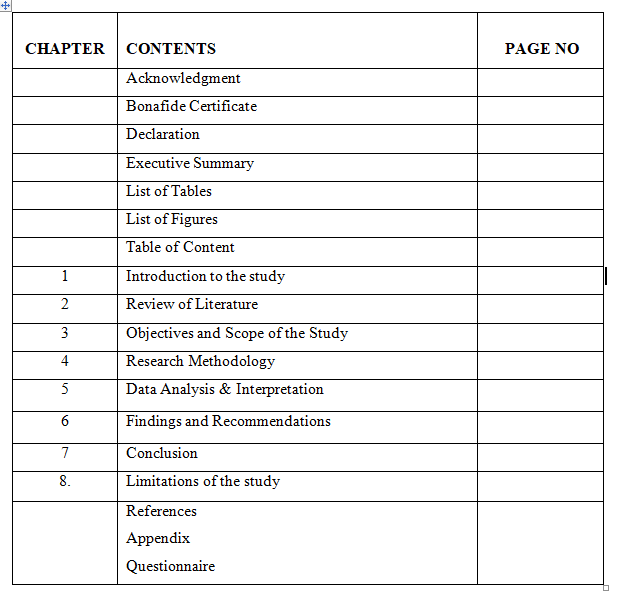
Table of Contents
Project Formatting Guidelines
The university recommends the following formatting standards:
- Font: Times New Roman
- Font Size: 12 (Body Text)
- Heading Size: 14
- Line Spacing: 1.5
- Text Color: Black
- Page Numbers: Right footer
- Properly labeled tables and figures
- APA referencing style
For more details contact us
9015596280, 9212129290